The ocean is taking the hit
The sea soaks up about a third of the carbon dioxide we release and more than nine-tenths of the extra heat. That keeps the air cooler than it would be. It also changes the water, and the things that live in it.
A sponge for carbon dioxide
NOAA says the ocean absorbs about 30 percent of the carbon dioxide released into the atmosphere. As the air holds more, so does the sea. NOAA: Ocean acidification When carbon dioxide dissolves in seawater, chemical reactions lower the pH and the amount of carbonate, the building block of shells and skeletons. NOAA PMEL: Ocean acidification
Since the Industrial Revolution began, the pH of surface seawater has fallen by 0.1. That sounds tiny, but the pH scale is logarithmic, like the Richter scale, so it means about a 30 percent increase in acidity. NOAA PMEL: Ocean acidification If emissions carry on as usual, NOAA’s Pacific Marine Environmental Laboratory says surface waters could be nearly 150 percent more acidic by the end of the century, a pH the ocean hasn’t seen for more than 20 million years. NOAA PMEL: Ocean acidification
It is not bad news for everything. The same NOAA page says algae and seagrasses that photosynthesise may benefit. NOAA PMEL: Ocean acidification But shell-builders such as oysters, clams, lobsters and corals are in for a harder time, which is why ocean acidification has been called “osteoporosis of the sea”. NOAA: A wake-up call
Even fish without shells notice. NOAA says some fish are worse at detecting predators in more acidic water. NOAA: Ocean acidification
Sea butterflies with dissolving shells
Pteropods, or sea butterflies, are tiny swimming snails that use their foot as wings to “fly” through the water. NOAA OAP: Plankton They grow to about one-eighth to one-half of an inch, and they are a vital food for salmon and other fish. NOAA: Pteropod shells NOAA says they also feed seabirds and whales in high-latitude seas. NOAA OAP: Plankton
In 2014 a NOAA-led team reported the first evidence that acidic water off the US West Coast was dissolving pteropod shells. They estimate the share of pteropods there with dissolving shells has doubled in nearshore waters since pre-industrial times, and is on track to triple by 2050. NOAA: Pteropod shells
The oysters had already sounded the alarm. In the mid-2000s, NOAA says, acidification nearly collapsed the West Coast shellfish industry, worth $117 million, when the water became so corrosive that baby oysters could not build their shells. NOAA: A wake-up call What saved it was an early warning system: stronger coastal monitoring and real-time data from ocean buoys. NOAA: A wake-up call
The fourth global coral bleaching event
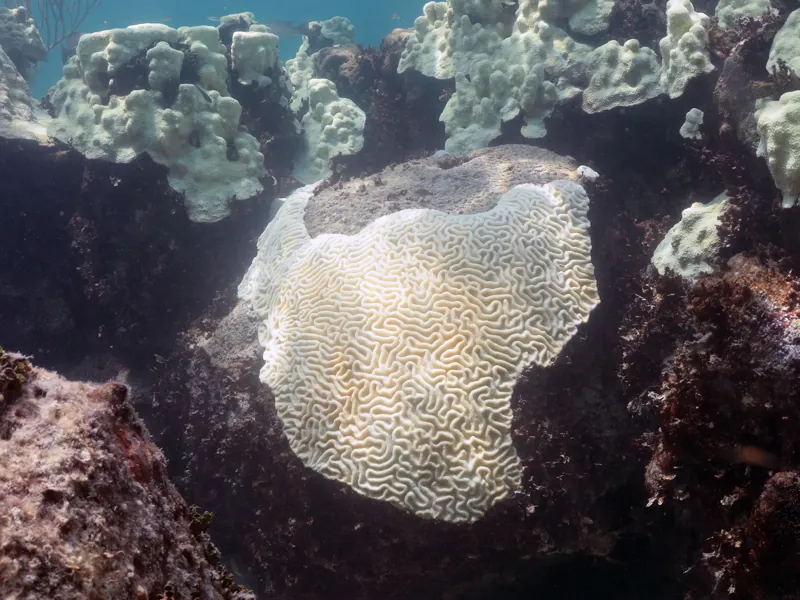
On 15 April 2024, NOAA confirmed the world was in a global coral bleaching event: the fourth on record, and the second in the last ten years. NOAA: 4th bleaching event
From February 2023 to April 2024, significant bleaching was documented in both hemispheres of every major ocean basin. Mass bleaching was confirmed across the tropics, from Florida and the Caribbean to Brazil, the eastern tropical Pacific and Australia’s Great Barrier Reef. NOAA: 4th bleaching event
NOAA’s Coral Reef Watch spots the danger from space, using sea surface temperatures from satellites going back to 1985. NOAA: 4th bleaching event Bleaching does not necessarily mean a coral will die: if the heat stress eases, corals can recover. If it is severe or lasts too long, they can die. NOAA: 4th bleaching event
4,000 robots in the deep
How do we know the ocean is warming, when most of it is dark and miles deep? Since 1999, much of the answer has come from Argo: a global fleet of almost 4,000 robotic floats that measure the temperature and saltiness of the top 2,000 metres of the ocean. NOAA GOMO: Argo
The floats work on a 10-day cycle: after 10 days they rise to the surface and send their data to satellites. NOAA GOMO: Argo Close to 30 countries take part, and NOAA says Argo provides nearly four times as much ocean information as all other observing tools put together. NOAA GOMO: Argo
The name is a little joke for the classically minded. Argo was the ship of Jason in Greek myth, and the floats work alongside the Jason satellites that measure sea height. NOAA GOMO: Argo New floats being tested can dive to 6,000 metres and carry sensors for oxygen, pH and nitrate. NOAA GOMO: Argo
Why the ocean matters to the rest of this site
The more than 90 percent of extra heat the ocean has taken up is the reason sea level rises even without melting ice. NOAA: Is sea level rising? For how much it has risen, and why it is falling in a few odd places, see sea level. For the gas doing the damage, see the causes and the other gases.
Facts on this page checked 24 November 2026. Figures marked “our fit” or “our calculation” are our own arithmetic on published data.
Next: the other gases →