What is climate change?
Two definitions, one big shift, and why the words matter.
A long-term shift
Climate change is a large-scale, long-term shift in the planet’s weather patterns and average temperatures. Met Office: What is climate change? NASA describes climate change as a long-term change in the average weather patterns that define Earth’s local, regional and global climates. NASA Science: What is climate change?
In the 11,000 years before the Industrial Revolution, the world’s average temperature held steady at around 14 °C. Met Office: What is climate change?
Climate change or global warming?
Global warming means the long-term heating of Earth’s surface seen since the pre-industrial period (1850 to 1900), caused mainly by burning fossil fuels. NASA Science: What is climate change?
NASA points out that “climate change” and “global warming” are often swapped around but do not mean quite the same thing. NASA Science: What is climate change?
What changed
The Met Office dates the start of the problem to the mid-1800s, when people began burning coal, oil and gas for fuel on a large scale. Met Office: What is climate change? Burning fossil fuels releases greenhouse gases such as carbon dioxide, methane and nitrous oxide. Met Office: What is climate change?
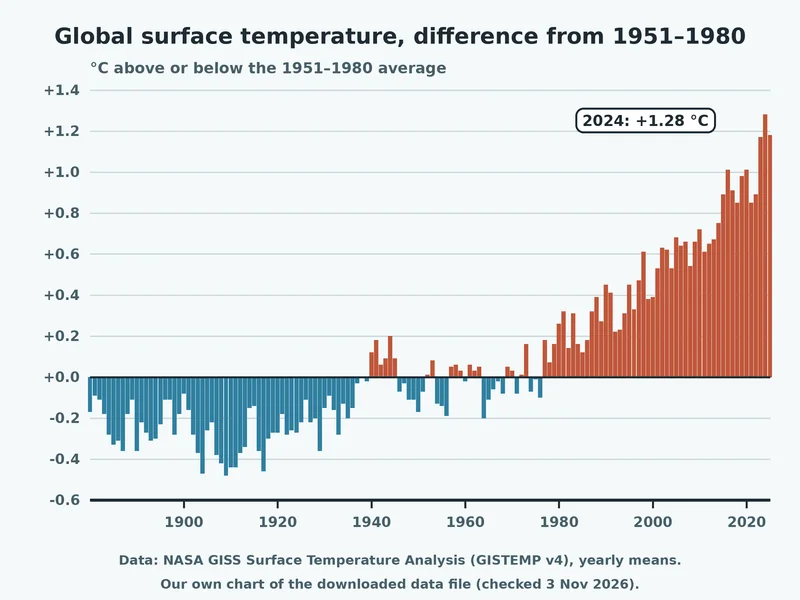
Since the Industrial Revolution the planet’s average temperature has risen by around 1.1 °C (IPCC Sixth Assessment Report). Met Office: What is climate change? For 2024, the World Meteorological Organization’s estimates of the current warming level ranged from 1.34 °C to 1.41 °C. Met Office: What is climate change?
Who says so
The Intergovernmental Panel on Climate Change (IPCC) was set up in 1988 to give governments the information they need to tackle climate change. Met Office: What is climate change? The IPCC’s 2021 report says human activity is unequivocally the cause of climate change. Met Office: What is climate change?
Scientists have ruled out natural causes such as volcanoes, changes in the Sun and natural sources of carbon dioxide as the main driver. Met Office: What is climate change?
How scientists can tell
The signs scientists track include warmer land and oceans, rising seas, ice loss at the poles and in mountain glaciers, and changes in extreme weather. NASA Science: What is climate change?
Scientists study climate change with observations from the ground, the air and space, plus computer models. NASA Science: What is climate change?
What comes next
Greenhouse gases can stay in the air for tens or hundreds of years, so some further warming can’t be avoided even if all emissions stopped today. Met Office: What is climate change?
If fossil fuel burning and forest clearing carry on at the same rate, the planet could warm by more than 4 °C by 2100. Met Office: What is climate change?
Some changes can’t now be prevented, but the sooner emissions are cut, the smaller the changes will be. Met Office: Effects of climate change
Next: the greenhouse effect →