The greenhouse effect
A blanket we can’t live without, and what happens when it gets thicker.
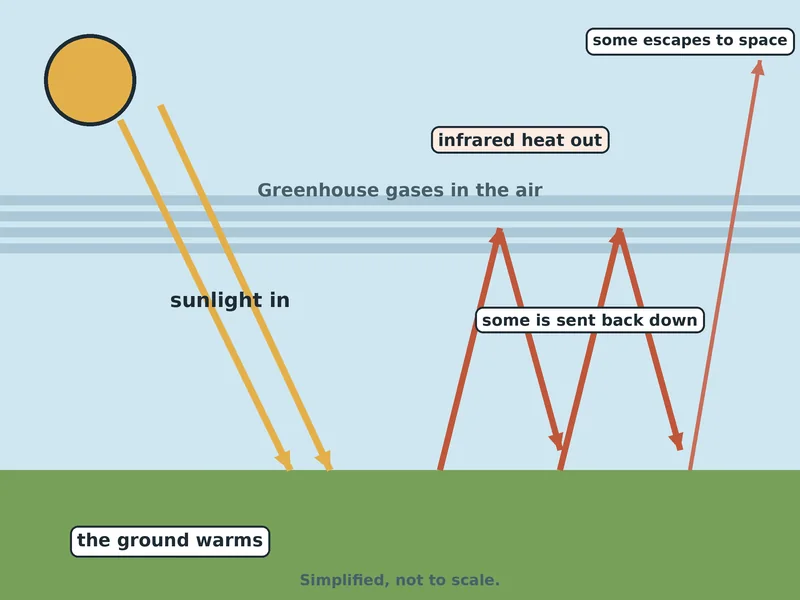
How it works
Greenhouse gases act like a blanket round the Earth: sunlight passes through, the ground warms and gives off infrared heat, and some of that heat is caught and sent back down. Met Office: What is climate change?
The greenhouse effect itself is vital: without it the Earth would be bitterly cold and people could not survive. Met Office: What is climate change? Without greenhouse gases, Earth would be about 30 degrees colder than it is today. Met Office: Causes of climate change
Britannica puts Earth’s average surface temperature without the greenhouse effect at only about −18 °C. Encyclopaedia Britannica: greenhouse effect
The gases
Water vapour is the greenhouse gas with the largest effect. Encyclopaedia Britannica: greenhouse effect
Some greenhouse gases occur naturally, like carbon dioxide, methane and nitrous oxide. Others, such as CFCs, are made only by people. Met Office: Causes of climate change
Burning fossil fuels releases greenhouse gases such as carbon dioxide, methane and nitrous oxide. Met Office: What is climate change?
Carbon dioxide alone is responsible for about 80% of the total heating influence of all human-produced greenhouse gases since 1990 (NOAA). NOAA Climate.gov (archived June 2025): Atmospheric carbon dioxide
The enhanced greenhouse effect
Adding extra greenhouse gases makes the blanket thicker. The Met Office calls this the enhanced greenhouse effect, and it is the main cause of climate change. Met Office: Causes of climate change
The Met Office says methane from farm animals is 30 times more powerful than carbon dioxide as a greenhouse gas, and nitrous oxide nearly 300 times. Met Office: Causes of climate change
Not really like a greenhouse
Despite the name, the greenhouse effect works differently from a glass greenhouse, which keeps heat in mainly by trapping warmed air. Encyclopaedia Britannica: greenhouse effect
Venus: the extreme case
On Venus, a thick carbon dioxide atmosphere causes an extreme greenhouse effect, with surface temperatures as high as 450 °C. Encyclopaedia Britannica: greenhouse effect
Where the idea came from
Joseph Fourier is sometimes credited with the idea, after comparing the atmosphere in 1824 to an insulated glass-lidded “hotbox”, though he never used the term greenhouse effect. Encyclopaedia Britannica: greenhouse effect
Svante Arrhenius is credited with the origins of the term, through the climate model he published in 1896. Encyclopaedia Britannica: greenhouse effect
There’s more on the history page.
Next: the causes →