The day Britain hit 40 °C
On Tuesday 19 July 2022, a thermometer at Coningsby in Lincolnshire read 40.3 °C. Nobody in Britain had seen 40 before. Then scientists set out to answer the obvious question: would it have happened without climate change?
The numbers
It was the first time temperatures of 40 °C or more had ever been forecast in the UK. WWA: UK 40°C On the Tuesday, Coningsby in Lincolnshire reached 40.3 °C, smashing the previous record of 38.7 °C set in 2019. WWA: UK 40°C Local records fell at 46 stations across the country. WWA: UK 40°C
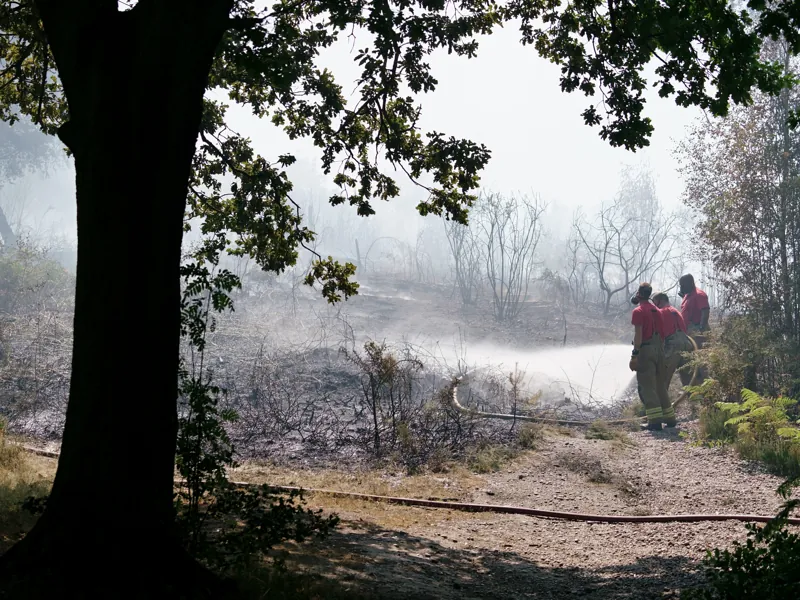
The nights were brutal too. Kenley in Surrey provisionally recorded a minimum of 25.8 °C, beating the previous record, set in 1990, by 1.9 °C. WWA: UK 40°C The minimum is the coolest it got all night.
The heatwave is estimated to have led to at least 13 deaths by drowning, and it put the NHS and care services under heavy strain, with a likely increase in heat-related deaths. WWA: UK 40°C
How rare was it?
Scientists at World Weather Attribution ran the numbers. For the region they studied, a day this hot is about a 1-in-1,000-year event in today’s climate. WWA: UK 40°C
At single stations it was rarer still: about 1 in 500 years at St James Park in London, about 1 in 1,000 at Durham, and about 1 in 1,500 years at Cranwell in Lincolnshire. WWA: UK 40°C In a world 1.2 °C cooler, the chance of seeing it was extremely low, and at two of the three stations it was statistically impossible. WWA: UK 40°C
What climate change did
Combining weather observations and computer models, the scientists found that human-caused climate change made the heatwave at least 10 times more likely. WWA: UK 40°C
The observations said a heatwave like this would have been about 4 °C cooler in pre-industrial times. The models said only about 2 °C, a much smaller change than was actually seen. WWA: UK 40°C In other words, this time the real world warmed its hottest days more than the models expected. That is not comforting.
Weather or climate? No single hot day proves climate change. Attribution science asks a narrower, answerable question: how much more likely, or how much hotter, did warming make this event? For the background, see what climate change is and the UK page.
Facts on this page checked 24 November 2026. Figures marked “our fit” or “our calculation” are our own arithmetic on published data.
Next: the end of coal →